How Do You Get Back Into Your Yoga Practice After a Break?
Sep 07, 2026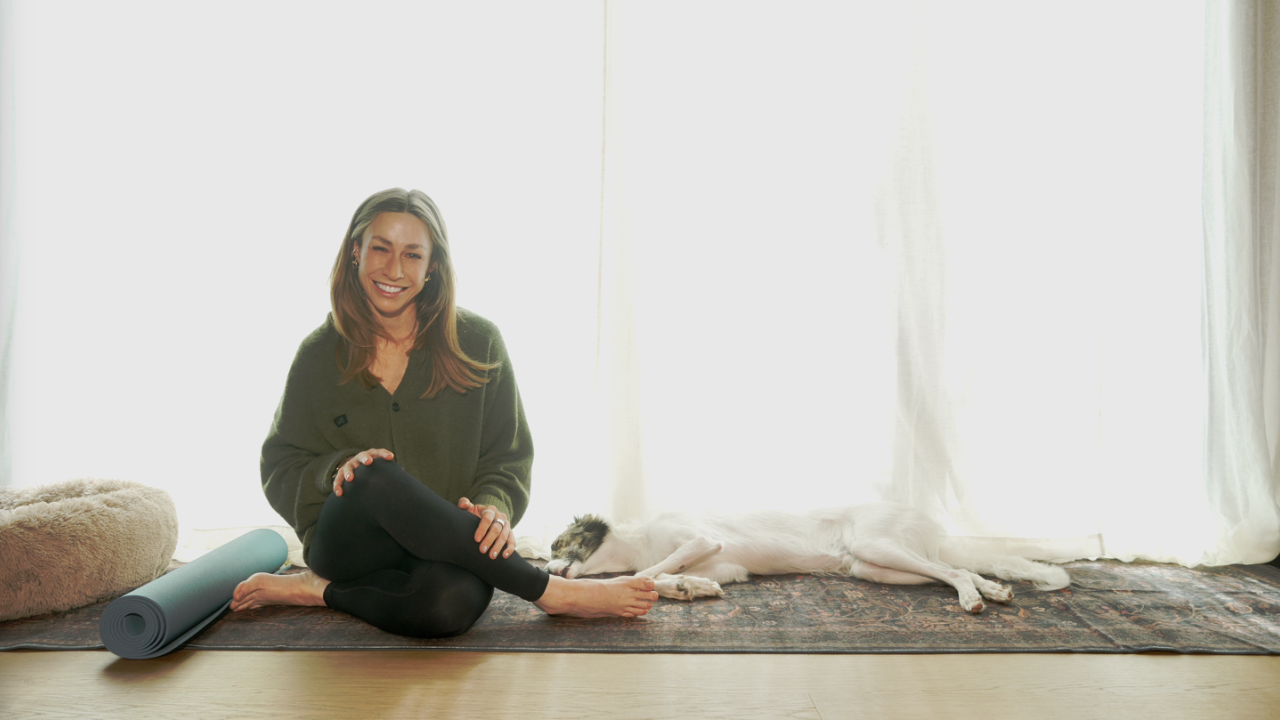
If you have been away from your mat for a while, you do not get back into your yoga practice by picking up exactly where you left off. You get back by making the practice small, soft, and shaped to fit the actual life you are living right now.
------
I'm writing to you from the living room floor (don't worry, thats actually pretty normal for me), surrounded by piles of laundry that started out clean and are getting less clean by the hour, up to my knees in beads and craft supplies and teeny-tiny half-made bracelets that are apparently colonizing every surface in my house. My daughter just started second grade (excuse me, how), summer is packing its bags, and I am somewhere between mourning it and being deeply ready for a little routine again.
The other day in Downward Dog, I pulled my head through, and before my gaze even made it to my big toes, I clocked three tiny seed beads stuck to my knees. And honestly? Better than a Lego underfoot. It felt like a pretty accurate little imprint of the life so many of us are actually living: joyful, cluttered, scattered, sweet. That is the exact life your practice has to fit into. Not some tidier imaginary one.
So if your mat has been gathering dust all summer (or all year, no judgment here), this one is for you.
So really, why is it so hard to get back into your yoga practice after a break?
Because the break is rarely just a break, and in my experience its usually more of a season. Travel, kids home from school, a move, a big work stretch, grief, joy, more grief, a few glimmers, lots of emails - all of it. And clutter, even the joyful kind, comes with a real cost: that low hum of brain-and-body overwhelm that makes the idea of "and now I will also do a 75-minute vinyasa" feel faintly ridiculous.
The other reason is way sneakier and so much more rude - we try to jump back in exactly where we left off, as if all of life in between hadn't left an imprint.
We remember the version of us who practiced five days a week, or who could float through the air with the greatest of ease (LOL 20/20 hindsight amiright?!) who could make it thorugh a 90 minute practice without huffing and puffing and we want to be right back in it. Right back THERE.
Sometimes you get real bold and really go for it, like day one gimme the Full Solar Practice and a hot room and while its both a beautiful return - its also sometimes a harsh blow when day one feels clumsy and much farther away from the memory we'd latched on to.
Heads bowed, morale low, usually we quietly decide we have "lost it", then trot back to our desks with our tails between our legs - and put the whole thing off again.
But, you have not lost it. I promise. You just might have gotten lost. Not realized that you are simply standing at a different doorway than the old one you walked out of. The real trick is to stop jiggling the handle, desperately trying to re-enter through the old one.
Do you have to start where you left off?
No. seriously, no. and also, please don't.
Coming back is not a test of whether you can still do the thing. It is an invitation to make the shapes fit you instead of contorting yourself to fit the shapes. When I teach a slower, mellower flow, we use props for basically everything: two blocks that become an extension of your arms (congratulations, you now have very long arms), a practice where nobody is rushing you anywhere. Not because you are fragile or behind, but because props let you feel the pose from the inside instead of white-knuckling your way toward some external picture of it.
(also, let me tell you about a little thing called Acute vs. Chronic Load Management (we can talk about it more in a future Yoga + Injuries course but this is a good reference for now if you're curious) which compares your recent 7-day training volume (fatigue) to your 28-day average training volume (fitness) via the Acute:Chronic Workload Ratio (ACWR) to help predict and prevent injuries. There is a very real relationship between what you've been doing, and what you will be able to immediately do so easing back into things is more than just a mental/emotional conversation - its a very literal tissue one.)
Okay, back to the inside stuff: the inside information has a name you've probably heard me say a thousand times: your Felt Sense. It is the felt, first-person experience of a shape, and it is worth infinitely more than how the pose looks from across the room. When you come back to your mat, your only job is to get reacquainted with that. Where is there space? Where is there gunk? What actually feels good today, in this body, on this floor, with these particular beads stuck to your knee?
What kind of practice should you come back to first?
Start with the practices that ask the least of your nervous system and the most of your curiosity. Two flavors I reach for again and again:
A mellow flow. If vinyasa generally feels like a lot (even a not-very-fast-paced one), or you are newer, or you are returning after a while, a slow prop-supported flow is the spot. It is a low-pressure place to get familiar again with the shapes, the terms, the props, and the options you have, without anyone hurrying you along. Slow is not lesser. Slow is where the relearning actually happens.
A short, focused Movement or mobility session. Fifteen to twenty-five minutes aimed at one thing, say, your shoulders, is often more doable and more satisfying than a full-length anything. A kinstretch-style shoulder session with a resistance band and a couple of light weights (or, in true Moved. fashion, two cans of soup) gives your joints some active, end-range work and reminds your body that it is allowed to be strong and mobile. These bite-size sessions are also easy to stack: pair a stretchy, opening practice one day with a stronger, more stabilizing one a couple of days later, and you have a rhythm without a big time commitment.
The theme underneath both: less spectacle, more spaciousness. You are not performing a comeback. You are re-opening a conversation with your body.
How often should you practice when you are rebuilding the habit?
Less than you think, more consistently than you would guess. Two short, intentional sessions a week that you actually do will rebuild the habit faster than a heroic five-day plan that collapses by Wednesday.
A few things that genuinely help the habit stick:
Schedule it like a class, even if it is a fifteen-minute mobility session at home. Putting it on the calendar turns "someday" into a specific Tuesday.
Build yourself a little follow-along. Stack a handful of individual exercises or a couple of short classes into your own playlist so you are not deciding what to do every single time. Decision fatigue is the quiet killer of home practice.
Keep notes. Jot down what felt good, what felt stuck, what you want to revisit. Watching your own Felt Sense change week to week is weirdly motivating, and it keeps you honest about progress that the mirror will never show you.
What if your practice looks messy and inconsistent?
Then it looks like a real practice belonging to a real person. Welcome.
I want to gently retire the fantasy that a "good" practice is a pristine, daily, uninterrupted streak. Mine has beads in it. Mine has a dog who occasionally tries to bite my ankles mid-standing-balance. Mine disappears for stretches and comes back when I need it. The whole point of the thing is not to escape the joyful chaos, it is to find some tiny semblance of spaciousness inside it, and then carry a little of that spaciousness back out into the laundry piles.
Your practice does not need to be impressive. It needs to be available. A version of Movement waiting in the wings for you, on the days you are the most locked-in you have ever been, and on the days you are barely holding it together. Both of those days count. Both of those days get a mat.
So roll it out. Fifteen minutes. Props out, expectations low, curiosity high. That is not a lesser practice. That is the practice.
Frequently asked questions
How long does it take to get back into a yoga practice after time off? Less time than you fear, if you start small. Most people feel noticeably more comfortable within two to three weeks of practicing a couple of short, gentle sessions per week. You are re-establishing a relationship, not passing a fitness test, so consistency matters far more than intensity.
Should I do gentle yoga or jump back into a strong flow? Start gentle, even if you used to practice hard. A mellow, prop-supported flow or a short mobility session lets your nervous system and joints re-acclimate without the soreness or discouragement that often comes from going too big on day one. You can always add intensity once the habit is back.
Is it bad that I can't do poses I used to do? Not at all. Capacity ebbs and flows with life, and it comes back with gentle, consistent Movement. Chasing an old version of a pose is the fast track to frustration or strain. Meeting the pose where your body is today, using props and your Felt Sense, is how you actually rebuild.
How do I stay consistent with a home practice when life is chaotic? Make it small and scheduled. Put a fifteen-minute session on your calendar, build a short follow-along playlist so you are not deciding what to do each time, and keep quick notes on how you felt. Tiny and repeatable beats long and occasional, every time.
What should I look for in a "beginner-friendly" class when returning? Look for words like mellow, slow, or prop-supported, and a teacher who invites options rather than one right shape. A good returning class re-introduces the shapes, the terms, and your choices at a pace that lets you feel what you are doing, instead of rushing you toward a finished picture.
Whenever you are ready to actually roll the mat out, come practice with me. Moved.Studio is full of short mobility sessions, mellow flows, and follow-along Movement built to fit into a joyfully cluttered life, no perfect streak required. Find it all at movedyou.org/studio, and I will see you on the mat.