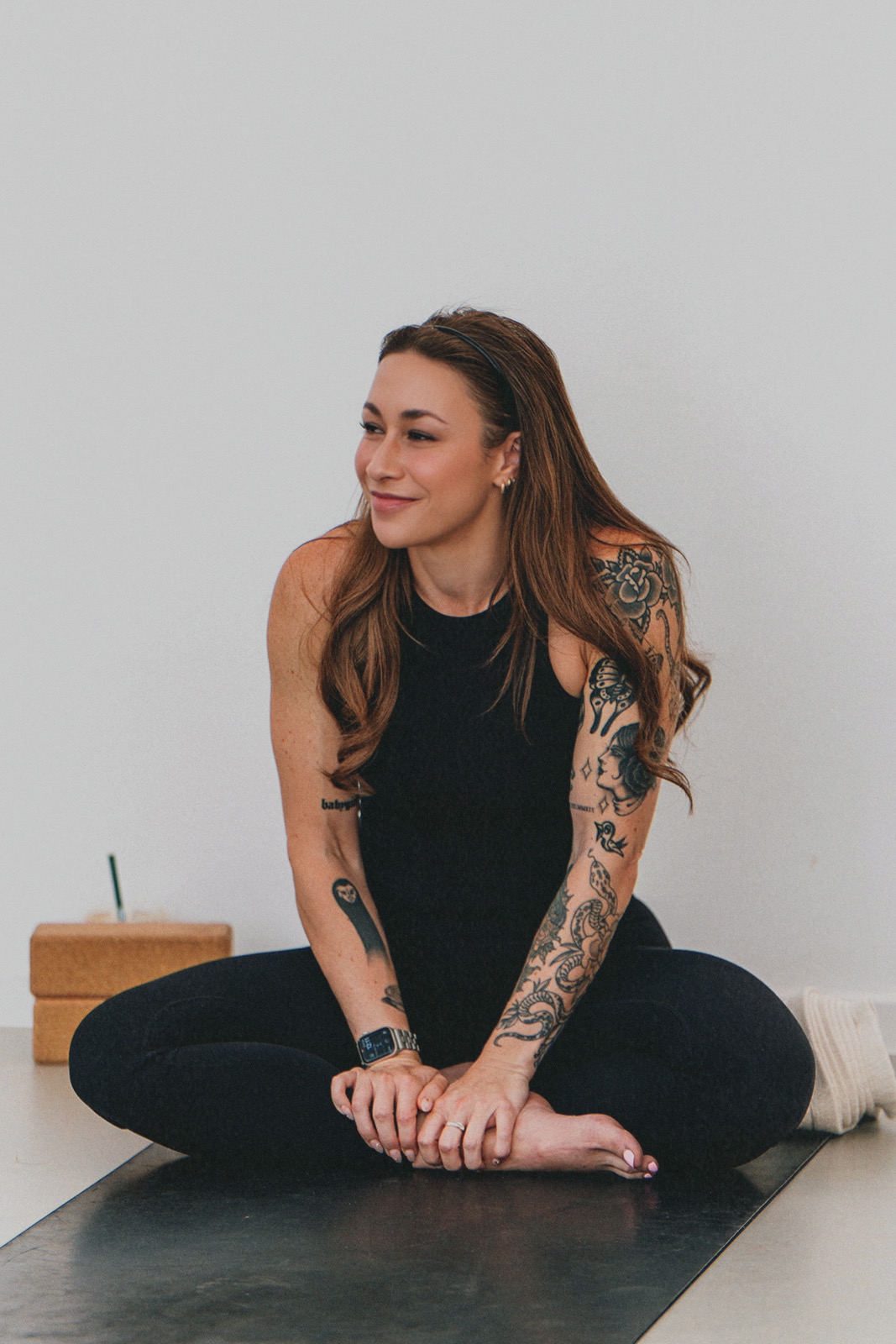
How to Teach Yoga for Every Body
Sep 01, 2026
The most inclusive thing you can do as a yoga teacher is ditch the rigid, universal rules and teach function, framework, and concepts instead. When you stop insisting a shape must look one exact way, you make room for the wildly different bodies actually standing in front of you (which, spoiler, is all of them). Let's meander through how to do that without losing the plot.
Inclusivity is a big, sprawling question. We could come at it from your language, or the literal postures you pick, or the physical spaces you teach in, and each deserves its own long ramble. Today I want the piece that lives closest to your mouth: the actual way you teach and the words you use when you offer up anatomy and alignment. Because that one you can start changing on Monday.
Why do "universal" alignment rules leave so many people out?
Here is my gentle beef, built over fifteen-plus years of teaching. If we are going to call something a universal alignment principle, then, by the literal meaning of the word, it needs to apply universally. To everyone. In every body. That sounds lovely on a slide.
But my honest finding is that most of these so-called universal rules are not universal at all. A lot of them were never built with other bodies, other cultures, or other styles in mind in the first place. So the second a rule meets a body it was not designed for, it quietly fails that person. And the feeling that creates is brutal: "oh, everyone can do this... oh, wait. Not me."
We have all felt that feeling somewhere, on a childhood playground or in our very grown-up regular lives. It is not where we want to be. And if that is the exact feeling your cueing is handing your students, I am going to say this with all the love I have (and I mean it, I am not trying to make you feel bad): that is a you problem. Not a them problem. The teaching, the sequencing, the whole shebang, is what needs the adjustment, not the person's perfectly good body.
Is yoga really "for every body"?
We love to say yoga is for everybody, and I do believe in that spirit. But it is also honest, and kind of freeing, to admit that not every single practice or every single teacher is actually offering something for absolutely everyone. That is just sometimes the truth of the matter.
So part of teaching inclusively is knowing who your people actually are. Who do you teach? How do you teach? It is entirely possible your particular class is not for everybody, and if so, the move is to be honest about that in how you advertise it and how you show up in your community. Clarity is a form of care. Pretending is not.
What does it look like to teach function instead of form?
This is the heart of it, so here is the word I keep coming back to (while side-eyeing it, because I go back and forth): functional. It gets overused to the point of meaning almost nothing, since you can argue everything is functional or nothing is, and honestly, fair enough on both counts.
But when you start thinking about a shape based on its function instead of its form, teaching for lots of different bodies gets so much easier. Everyone has a function based on what they need and what they actually do in their life. Which means a posture can look completely different from body to body and still be doing its job.
Take Warrior. The function we want is a stable, grounded base. So if a student takes their feet as wide as the mat because that is where they feel steady and strong, guess what, that is in alignment with the aim of the pose. That is congruent. Whereas if I force that same person into a tidy heel-to-heel line and they wobble all over the place like a newborn giraffe, that is not functional, and it is not serving the posture at all, no matter how "correct" it looks from the front of the room.
Function over form moves the question from "is everyone doing the identical thing" to "is this doing what it is meant to do for this person." Way better question.
How do you make options and props feel normal instead of like a consolation prize?
Get less and less attached to it must be this way, and it gets so much easier to see that it could be a lot of ways. Same way a body can look a lot of ways, and strength can look a lot of ways, and health can look a lot of ways. Step away from the binary, and a whole bunch of doors swing open.
So normalize it. Options, regressions, progressions, props, variations, a student's own interpretation of a shape. Two things happen when you do:
One, the practice belongs to them, so let them have it. Great. Done.
Two, and this is the one teachers snag on: it is not a personal affront to you when a student does it differently. Not when their body dictates it, not when their mind dictates it, not for any reason at all. The moment you stop taking that personally and just expect people to practice in the way that works for them, the room changes. Suddenly you get to look around and think, "oh my gosh, I never thought about it that way," or "look at them, they figured it out." You get to offer this bigger, wider galaxy of a practice instead of a tight little box. Because realistically, when we try to control every last detail, what we are actually doing is excluding people, bodies, variations, and options. The control is the thing quietly shutting people out.
Can two people in totally different shapes be having the same experience?
Yes, and this is my favorite reframe: validate the sensation over the final shape. Journey versus destination, except with actual bodies attached.
Instead of "you should feel this exact stretch right here" (movement histories differ, and where the tension lives differs, so they might not feel it there at all), talk about a spectrum of sensation. If everyone is chasing a seven out of ten, that seven is going to look wildly different from person to person. For one student, sitting upright in Dandasana with straight legs is a genuine seven. For another, a full fold is their seven. Totally different pictures. Same felt sense, same experience.
It can still feel like a cohesive class. Everyone is in the same tone even though they look nothing alike. That only works, though, once you decide you are okay with it all looking different.
Doesn't more anatomy knowledge just make you more rigid?
It really does not have to, and please do not let it. My hope is that learning this stuff never leaves you standing there smugly certain you know exactly how a pose is supposed to go. Because you don't. You just know more. And knowing more should fling the doors and windows open, not nail them shut.
Develop the x-ray vision, absolutely. Learn the bones and the muscles and the tendons. But do not let the 3D model and the dissection videos replace the real, breathing, moving humans in front of you. The knowledge only matters if you can apply it to them and their function and their needs. Learn it technically, then watch it play out practically in the room, and let the two overlay. That is where the good teaching lives.
So there it is, my whole guiding philosophy, kept intentionally open-ended instead of a tidy list of "never say this, always say that." Ditch the rigid rules. Focus on framework, concepts, sensation. Normalize options and variation across every posture, style, and student. Function over form. Keep that in your back pocket as the foundation, and everything else gets easier to build.
Frequently asked questions
What does inclusive yoga teaching actually mean? It means teaching in a way that welcomes many different bodies, rather than forcing everyone into one "correct" shape. Practically, that looks like offering function, frameworks, and concepts instead of rigid universal rules, and normalizing options, props, and variations.
How do I teach alignment for different body types? Focus on the function of the posture, not its exact form. Ask what the shape is meant to accomplish (stability, a certain sensation) and let it look different from body to body, as long as it serves that aim.
What does "function over form" mean in yoga? It means judging a posture by whether it does its job for that person, not by whether it matches a picture. A wide-footed Warrior that feels stable is more "in alignment" than a narrow one that leaves someone wobbling.
How can I cue sensation instead of a fixed shape? Offer a spectrum of sensation, like aiming for a seven out of ten, instead of "feel it right here." A seven can look completely different from student to student while still creating a shared, cohesive experience.
Does yoga really work for every body? The practice can be deeply inclusive, but it is also honest to acknowledge that not every class or teacher is for everyone. Know who you actually teach, and be clear about it in how you advertise and show up.
Learn the why with me
If this "wait, why do we teach it that way" thinking lights you up, it is honestly the whole heart of my work with teachers. My anatomy training for yoga teachers digs into exactly this: the function behind the shapes, so you can teach real, different humans instead of policing one perfect form. And if you want more of this energy, here are five outdated yoga cues it is time to retire. Come develop the x-ray vision with me, without losing sight of the people.